
Summer is ending. The road trips are slowing down. Temperatures are starting to drop.
And then one morning you turn the key.
Click. Click. Nothing.
Or maybe the engine turns over but refuses to start.
After months of summer heat, long highway trips, stop-and-go traffic, towing boats and campers, and running the A/C constantly, September is a good time to find out what all that driving did to your vehicle.
AAA reported that nearly 405,000 motorists needed roadside assistance during last year’s Labor Day holiday period. Towing, battery problems, and flat tires were among the most common reasons drivers needed help.
If you’re searching “towing near me” because your vehicle suddenly won’t move, there’s usually a reason.
Here are seven common problems that can leave Michigan drivers stranded as summer turns into fall—and when it’s smarter to call US23 Towing instead of trying to force the vehicle home.
1. Your Battery Took a Beating During Summer
People usually associate dead batteries with winter.
But the damage often starts during summer.
High temperatures are tough on automotive batteries. By September, a battery that was already getting weak may finally begin showing symptoms.
Watch for:
- Slow engine cranking
- Clicking when turning the key
- Dim headlights
- Flickering dashboard lights
- Electrical accessories acting strangely
- Needing repeated jump-starts
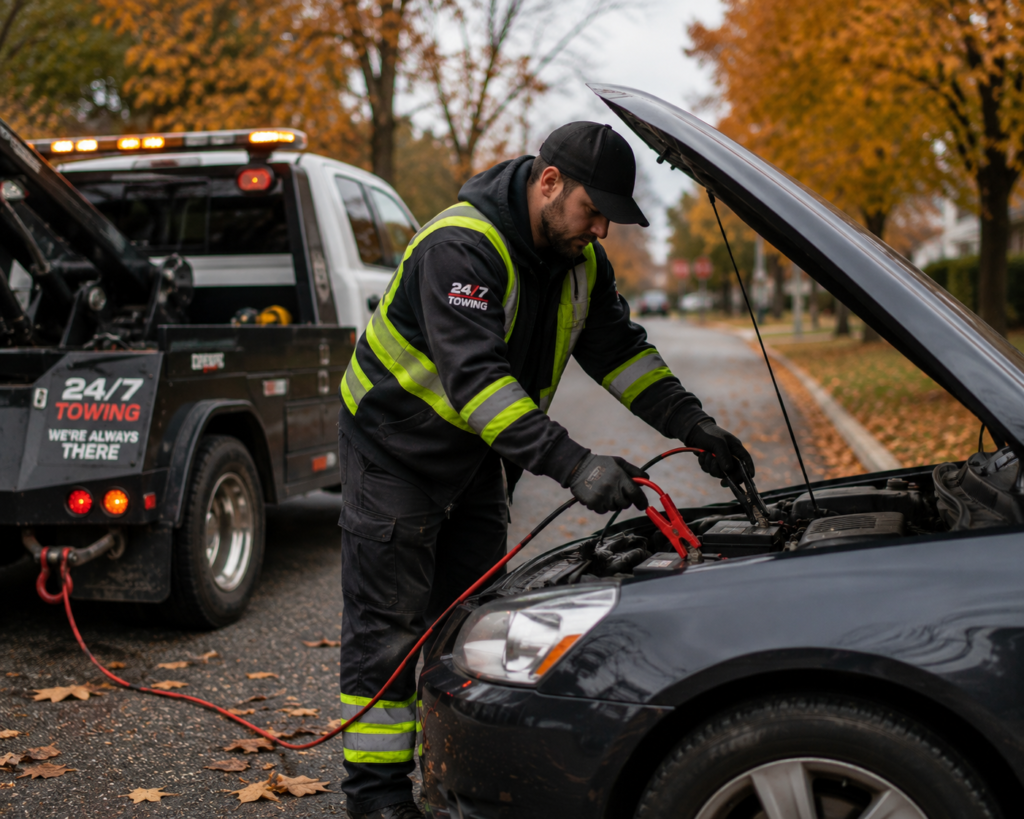
If the engine won’t crank at all, the battery is one of the first things to suspect.
A jump-start may get you moving temporarily. But if the battery isn’t the real problem—or the alternator isn’t charging correctly—you could be stranded again a few miles later.
That’s when professional roadside assistance in Michigan makes more sense than repeatedly trying to jump the vehicle yourself.
2. Your Alternator Is Failing
A new battery won’t solve the problem if your alternator isn’t charging it.
The alternator supplies electricity while the engine is running and keeps your battery charged.
Common warning signs include:
- Battery warning light
- Dim headlights
- Flickering electronics
- Burning smell
- Vehicle suddenly shutting off
- New battery repeatedly dying
An alternator can deteriorate gradually and then fail completely.
Once it does, your vehicle runs only as long as the battery has enough remaining power.
Eventually everything shuts down.
If that happens while you’re driving, safely get off the roadway and call US23 Towing.
3. Your Tires Are Worn After Summer Driving
Think about how many miles you put on your vehicle during summer.
Vacations.
Weekend trips.
Construction zones.
Highway driving.
Hot pavement.
All of it wears tires.
By September, tires that looked acceptable in spring may have significantly less tread.
Check for:
- Low tread depth
- Cracks
- Bulges
- Uneven wear
- Frequent pressure loss
- Vibration while driving
Michigan potholes add another problem. The Michigan Department of Transportation warns that potholes can damage tires, wheels, steering, suspension, and alignment.
A blowout on a quiet residential street is one thing.
A blowout at highway speed is completely different.
If changing the tire would put you close to traffic, don’t risk standing inches away from passing vehicles.
Call for roadside assistance.
4. Your Cooling System Has a Problem
Summer may be over, but damage caused by overheating doesn’t disappear when temperatures cool down.
Your cooling system depends on:
- Coolant
- Radiator
- Thermostat
- Water pump
- Cooling fans
- Belts and hoses
A small coolant leak can eventually become a major problem.
Watch for:
- Temperature gauge climbing
- Coolant underneath the vehicle
- Sweet smell
- Steam under the hood
- Heater behaving strangely
- Overheating
Never try to “make it home” with an overheating engine.
That decision can turn a cooling-system repair into major engine damage.
Pull over and call US23 Towing.
5. Your Brakes Are Telling You They’re Done
Summer driving can put serious mileage on your brakes.
By September, you may notice:
- Squeaking
- Grinding
- Steering-wheel vibration
- Vehicle pulling while braking
- Soft brake pedal
- Longer stopping distances
Grinding is especially serious.
Once the brake pad material wears away, metal components can begin damaging your rotors.
And if the vehicle no longer stops predictably, don’t drive it to the shop just because the shop is “only a few miles away.”
A tow is cheaper than an accident.
6. Your Starter Is Failing
You turn the key and hear one click.
The battery seems fine.
Lights work.
But the engine doesn’t turn over.
You could be dealing with a starter problem.
Common starter symptoms include:
- Clicking
- Intermittent starting
- Engine refusing to crank
- Grinding during startup
- Vehicle starting sometimes but not others
Starter problems rarely improve on their own.
If you’re stuck in your driveway, workplace, parking lot, or somewhere else with a vehicle that refuses to start, professional towing can safely transport it to a repair shop.
7. Something Simply Doesn’t Feel Right
Don’t underestimate your own familiarity with your vehicle.
You drive it every day.
You know how it normally sounds.
You know how the steering normally feels.
You know how it normally brakes.
If suddenly you’re hearing:
- Knocking
- Grinding
- Clunking
- Squealing
- Rattling
or you’re experiencing:
- Loss of power
- Hard steering
- Strange shifting
- Smoke
- Burning smells
pay attention.
Vehicles often give warning signs before major failures.
The smart move isn’t seeing how much farther you can push it.
It’s figuring out what’s wrong before a minor repair becomes a major one.
What Should You Do If Your Car Breaks Down?
First, get somewhere safe if the vehicle can still move.
Turn on your hazard lights and get as far away from moving traffic as safely possible.
Michigan State Police generally recommends that motorists with disabled vehicles stay inside with their seat belt buckled while waiting for help.
Then call for professional roadside assistance.
Tell the dispatcher:
- Your location
- Vehicle make and model
- What happened
- Whether the vehicle starts
- Whether it can roll
- Whether you’re safely off the road
The more information you provide, the better prepared the tow operator can be.
Frequently Asked Questions
Why won’t my car start even though the lights work?
Your battery may have enough power for lights but not enough amperage to crank the engine. Starter, alternator, ignition, or fuel-system problems are also possibilities.
Should I keep trying to start my car?
Repeatedly cranking a vehicle that won’t start usually isn’t helpful and can drain the battery. If several normal attempts fail, get the vehicle diagnosed.
Can summer heat damage a battery?
Yes. Summer heat can accelerate battery deterioration. AAA recommends beginning battery testing around three years of age because batteries commonly last roughly three to five years.
Should I drive if my brakes are grinding?
Don’t take the risk. Grinding can indicate severe brake-pad wear and possible rotor damage.
When Your Vehicle Won’t Move, US23 Towing Will
A breakdown doesn’t need to ruin your entire day.
Whether you’re dealing with a dead battery, flat tire, mechanical failure, overheating vehicle, or a car that simply refuses to start, US23 Towing is ready to help get you and your vehicle off the road safely.
Instead of waiting until you’re stranded to start searching “towing near me,” save the US23 Towing number now.
US23 Towing: 810-655-5959
When the unexpected happens, you’ll already know who to call.