Breakdowns never happen at a convenient time.
Whether you’re stuck on a busy highway, pulled over on a rural back road, or stranded in a parking lot at night, your first priority isn’t figuring out the problem—it’s staying safe until help arrives.
Most drivers immediately search towing near me when their vehicle stops working, but not everyone knows what to do before the truck arrives. And that part is critical.
Every year, roadside accidents involving stranded vehicles cause injuries, damage, and even fatalities—many of which could have been prevented with proper precautions. Your vehicle can be replaced. You can’t.
This guide gives you straightforward, essential roadside safety steps designed for real-world situations. Whether your engine dies, you blow a tire, or your battery quits in the middle of winter, these tips will protect you while you wait for a tow truck.
Let’s break down the exact steps every driver should follow.
1. Stay Calm and Assess Your Surroundings
The first few seconds after a breakdown are the most important.
Your vehicle may:
- Lose power suddenly
- Slow down unexpectedly
- Make strange noises
- Pull to one side
- Release smoke or steam
- Flash warning lights
Your goal is simple: avoid panic and stay in control.
Take a breath.
Keep both hands on the wheel.
Watch the traffic around you.
The decisions you make in the next 10 seconds determine how safe you are until help arrives.
2. Move Your Vehicle to a Safe Location—If Possible
If your vehicle still has enough momentum, get it out of traffic immediately.
Prioritize these safe spots:
✔ The shoulder of the road
Move as far right as possible. Ideally, beyond the rumble strip.
✔ A designated breakdown lane
✔ A nearby parking lot or driveway
This is safest if accessible without crossing traffic.
✔ A wide, flat area on the roadside
Avoid curves where approaching drivers can’t see you.
✔ Dirt pull-offs or grassy areas
Better than blocking traffic.
If your car shuts off while you’re in a lane:
- Turn on hazard lights immediately
- Shift into neutral
- Steer gently toward safety while coasting
Do NOT try to push your vehicle in heavy traffic—this is one of the most dangerous mistakes drivers make.
3. Turn On Your Hazard Lights Immediately
Your hazard lights are your first line of defense.
They tell other drivers:
- “This vehicle is stopped.”
- “Something is wrong.”
- “Give me space.”
In low visibility situations—rain, fog, snow, nighttime—they can prevent a serious collision.
Turn them on the moment you realize your vehicle is failing.
4. Stay Inside the Vehicle Unless It’s Unsafe
This is the single most important roadside safety rule:
STAY INSIDE YOUR CAR.
The outside lane of traffic is extremely dangerous.
Vehicles on highways travel at 70+ mph—and distracted drivers drift constantly.
Standing outside your car puts you at risk of:
- Being struck by passing vehicles
- Being hit by another stranded driver
- Being invisible in low light
- Slipping in snow, rain, or ice
Stay inside with your seatbelt on unless:
- Your car is smoking or on fire
- You smell gas
- You are in direct danger (blind curve, fast traffic approaching, unstable ground)
If you must exit, go out the passenger side, away from traffic.
5. Call for Help Immediately
Once you’re safe, call for professional towing.
Drivers often waste precious time searching for towing near me, reading reviews, or calling random numbers.
This is why you should always save your tow company’s number in advance.
When calling for help, be prepared to give:
- Your exact location
- Any mile markers or landmarks
- The issue you’re experiencing
- Your vehicle make and model
- Whether you’re in a safe location
- Whether you are in or near the roadway
Clarity speeds up response time.
6. Make Your Vehicle as Visible as Possible
Visibility prevents accidents.
Beyond hazard lights, consider:
✔ Turning on interior dome light at night
This adds soft, visible glow.
✔ Opening the hood
This is a universal sign of breakdown.
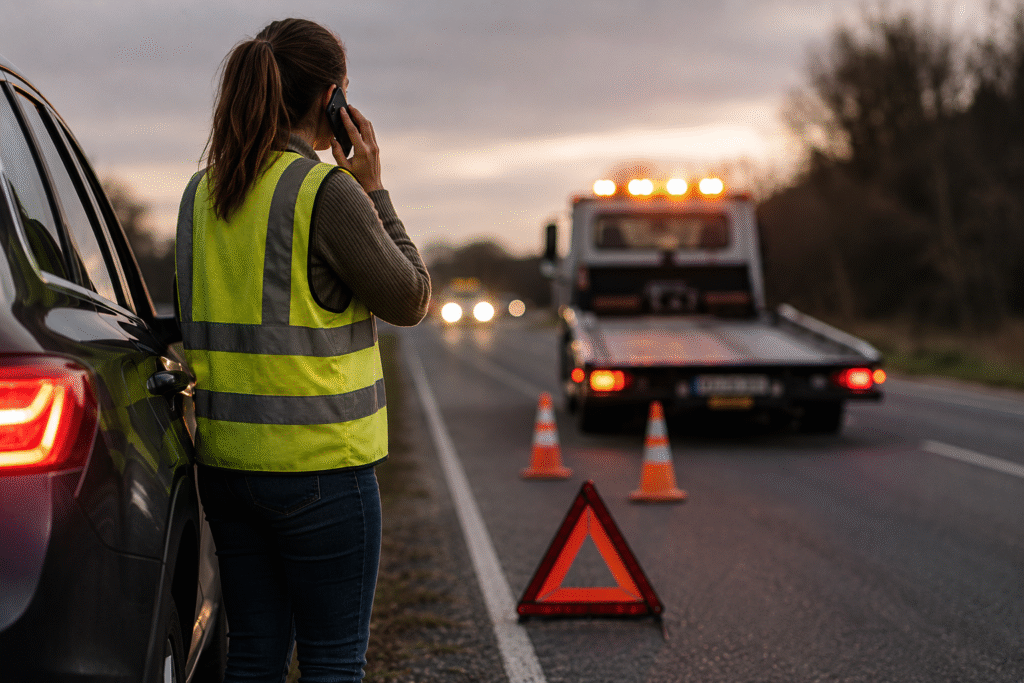
✔ Using reflective triangles
Place them:
- 10 feet behind the vehicle
- 100 feet behind the vehicle
- 200 feet if on a high-speed road
✔ Wearing a reflective vest if you must exit
Keep one in your glove box.
The more visible you are, the safer you’ll be.
7. Avoid Standing Between Your Vehicle and Traffic
If your vehicle is struck while you’re outside, the force of impact is devastating.
NEVER stand:
- Behind your car
- In front of your car
- Beside the driver-side door
- Near the flow of traffic
If you must exit, keep distance from both your vehicle and the roadway.
8. Use Your Phone Strategically
Your phone is a safety tool.
Use it to:
✔ Call for professional towing
✔ Mark your location on maps
✔ Share your location with family
✔ Check traffic reports
✔ Check weather conditions
But avoid:
- Posting on social media
- Draining your battery
- Walking around distracted
- Calling random tow companies
Stay focused on your safety first.
9. Keep Emergency Essentials in Your Vehicle
Every vehicle—especially in Michigan—should include:
- A reflective vest
- Roadside triangles or flares
- A flashlight with extra batteries
- A phone charger
- A fully-inflated spare tire
- A tire jack and wrench
- Blankets (for winter breakdowns)
- Water
- Portable jump starter
- First aid kit
Even if you’ve never used them before, these supplies can save your life.
10. Be Extra Cautious at Night or During Poor Weather
Breakdowns at night or in bad weather multiply risk.
Drivers are less alert.
Visibility drops.
Braking distance increases.
Road surfaces become slippery.
If it’s dark:
- Use dome light for visibility
- Activate hazard lights
- Keep your phone brightness low
- Avoid standing outside unless necessary
If it’s raining, snowing, or icy:
- Stay inside the vehicle
- Avoid standing near the roadway
- Keep windows up
- Keep seatbelt on
- Conserve battery power
Michigan winter breakdowns require even more caution.
11. Don’t Accept Help From Random Strangers
It’s common for strangers to stop and offer help.
Sometimes they mean well.
Sometimes they don’t.
Either way—your safety comes first.
Politely decline and say:
“Thank you, but a tow truck is already on the way.”
Professional towing companies are:
- Trained
- Insured
- Equipped
- Background checked
Random individuals are not.
12. Don’t Try to Fix Dangerous Problems Yourself
Even if you understand cars, the roadside is NOT the place for DIY repairs.
Avoid:
- Changing tires on a narrow shoulder
- Lifting your vehicle with unstable jacks
- Checking under the hood in traffic
- Walking around your car
- Attempting engine repairs
- Adding fuel on a busy road
- Working in poor visibility
Let the professionals handle it.
13. Communicate Clearly With the Tow Operator
When the tow truck arrives:
- Stay inside until the driver signals
- Use hazard lights until loading begins
- Follow instructions
- Keep distance during loading
- Avoid standing near cables or winches
Towing equipment is powerful and dangerous.
Your driver will walk you through everything.
14. Know These High-Risk Breakdown Locations
Certain areas are more dangerous:
❌ Left shoulder of the highway
Drivers do not expect stopped vehicles here.
❌ Curves or blind turns
Approaching vehicles cannot see you.
❌ High-speed zones
More speed = more danger.
❌ Bridges
Little room and no runoff areas.
❌ Narrow shoulders
Leave the vehicle if safe and move away.
❌ Ramps
Traffic accelerates and merges unpredictably.
If you break down in इनमें, follow extra caution.
15. Stay With Your Vehicle Unless It’s Unsafe
Police and towing professionals recommend staying inside because:
- It protects you from traffic
- You’re easier to locate
- Your vehicle shields you
- You avoid dangerous terrain
Exit only if:
- The vehicle is smoking
- There’s a fire risk
- You’re stuck in an active lane
- It’s safer outside than inside
When exiting, always use the passenger side.
16. Protect Your Personal Information
Breakdowns make you vulnerable.
Keep:
- Doors locked
- Windows partially closed
- Wallet out of sight
- Electronics hidden
You don’t need to open the door for anyone except police or tow drivers you called.
17. Teach Family Members These Roadside Safety Steps
If your spouse, kids, or teenagers drive, teach them:
- How to pull over safely
- How to use hazard lights
- How to stay inside
- Who to call
- What NOT to do
- How to remain calm
Share your saved tow company number with them.
Roadside safety saves lives.
18. Waiting for Help Doesn’t Have to Be Stressful When You’re Prepared
When you know:
- Where to go
- What to do
- Who to call
- How to stay safe
You stay calm—and in control.
Breakdowns become manageable instead of chaotic.
Preparation turns fear into confidence.
19. The Biggest Mistake Drivers Make During Breakdowns
Drivers often try to:
- Fix the problem in traffic
- Push the vehicle across lanes
- Stand outside waving
- Flag down strangers
- Walk along the highway
- Exit the car on the driver’s side
All of these are extremely dangerous.
The correct move is simple:
Get safe, stay visible, stay inside, call for help, and wait.
20. Final Roadside Safety Checklist
Before your tow truck arrives:
✔ Move your vehicle to safety
✔ Turn on hazard lights
✔ Stay inside the vehicle
✔ Call your towing company
✔ Make your vehicle visible
✔ Lock your doors
✔ Avoid strangers
✔ Teach others these steps
When in doubt, staying inside and staying calm is always the safest choice.
When You Need Safe, Reliable Roadside Help—Call a Tow Company You Trust
If you ever find yourself stranded, stuck, or dealing with a dangerous breakdown, professional help is just a call away.
Searching towing near me is good—but having a trusted tow company’s number already saved is even better.
✔ Fast response
✔ Experienced operators
✔ Safe loading and transport
✔ 24/7 emergency service
✔ Professional equipment
Your safety always comes first.
Save This Number Now: 810-655-5959
Your trusted, local towing professionals.
Whether you’re broken down on the highway, stuck in the snow, or facing an unexpected emergency—call:
📞 810-655-5959
Reliable service. Fast response. Safety-focused every step of the way.