When your vehicle breaks down, you’re not thinking about towing classifications, equipment types, or dispatch logistics. You’re thinking about one thing:
“How do I get myself and my vehicle out of this situation safely — and fast?”
But there is a big difference between regular towing and emergency towing, and choosing the wrong one can cost you extra money, extra stress, and even put you in danger.
Most drivers don’t realize this until they’re the ones stuck on the shoulder of a busy highway or trapped in a dead lane of traffic with cars flying past at 75 mph.
This is the no-nonsense guide that breaks down both services in plain English — the way real drivers appreciate it. By the end, you’ll know exactly which towing service to request, when to request it, and what kind of tow protects your vehicle best (hint: flatbed towing is the king).
Let’s get into it.
1. What Regular Towing Actually Means
Regular towing is the most common type of service people imagine when they think of tow trucks.
It’s planned. Predictable. Not rushed. Not dangerous.
Regular towing is ideal for situations like:
- Your vehicle won’t start in the driveway
- A dead battery at work
- A no-start issue in a parking lot
- Transporting a vehicle to a shop for repairs
- Moving a project car
- Low-risk breakdowns in a safe location
The key here is:
You’re safe. The vehicle is safe. Traffic isn’t being disrupted.
Regular towing typically involves:
- Slower response times (because the situation isn’t urgent)
- Standard pricing
- Straightforward pickup
- Calm, controlled loading
- The option of flatbed towing if needed
In other words — if you’re not in immediate danger, regular towing gets the job done without urgency fees or high-pressure conditions.
2. What Emergency Towing Means — And Why It’s Completely Different
Emergency towing is a whole different world.
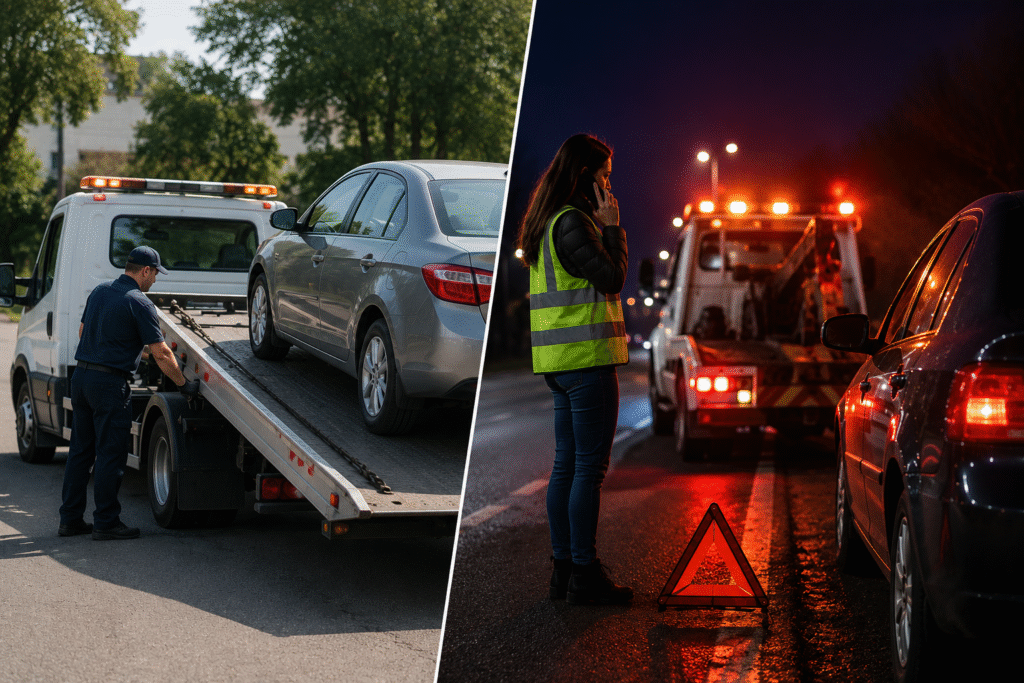
Emergency towing is reserved for scenarios where time, traffic, and safety are critical.
When things go wrong suddenly, violently, or dangerously, the response has to fit the situation.
You need emergency towing when:
- Your vehicle breaks down in an active lane
- You’re stranded on a high-speed highway
- Smoke, fire, or leaking fluids are visible
- You’ve been in a collision
- You’re blocking traffic
- Your vehicle is at risk of being hit
- The breakdown occurred in a blind curve or a dangerous location
Emergency towing involves:
✔ Fast response times
Priority dispatch. No waiting for hours.
✔ Special safety procedures
Road cones, flares, lane blocking, hazard protection.
✔ Highly trained operators
You need someone who knows how to control the scene.
✔ Emergency transport equipment
Like heavy-duty winches, stabilizers, and yes — flatbed towing (most emergency scenarios require it).
✔ Higher risk = higher responsibility
A poorly trained operator can create a secondary crash.
✔ Protecting YOU, not just your vehicle
Emergency towing starts with one objective:
Get you out of harm’s way. Immediately.
In short:
Regular towing is a service. Emergency towing is protection.
3. The Number One Question: Which Type Do YOU Need?
Most drivers don’t know which option to choose — and that’s understandable.
Breakdowns aren’t exactly planned events.
So here’s the simplest way to choose:
Choose REGULAR towing if:
- Your vehicle is safely off the road
- You’re in a driveway, parking lot, or neighborhood
- Nothing is leaking
- There was no crash
- You’re not blocking traffic
- You’re calm and comfortable waiting
Choose EMERGENCY towing if:
- You are NOT in a safe place
- Your car is disabled in a lane
- Traffic is approaching at high speeds
- You’re on a shoulder with barely any space
- It’s dark, icy, foggy, or low visibility
- Your vehicle is smoking, leaking, or steaming
- You feel unsafe for ANY reason
If you’re unsure, assume emergency towing.
It’s better to overreact than underestimate danger.
4. When You Should Always Request Flatbed Towing
Regardless of whether you need regular or emergency towing, many vehicles should ONLY be moved using flatbed towing.
Flatbed towing keeps your vehicle elevated completely off the road.
All four wheels off the ground = maximum protection.
Flatbed towing is best for:
- AWD and 4×4 vehicles
- Lowered cars
- Luxury vehicles
- EVs (electric vehicles)
- Vehicles with transmission problems
- Cars with wheel, brake, or suspension damage
- Cars that cannot roll (locked wheels, seized axle, etc.)
Why flatbeds matter:
- No dragging
- No transmission damage
- No risk of bumper scraping
- No wheel lift stress
- No uneven towing forces
- No long-distance wear
In emergency situations, flatbeds are often the ONLY safe option.
If your vehicle is smoking, damaged, stuck, or unable to roll, wheel-lift towing simply isn’t safe.
5. Why Emergency Towing Requires a Higher Level of Skill
Most people think towing is just hooking up a vehicle and hauling it.
Not even close.
Emergency towing is one of the most dangerous roadside professions.
Operators must deal with:
- High-speed traffic inches away
- Poor visibility
- Unpredictable drivers
- Limited space
- Weather hazards
- Damaged vehicles
- Active collision scenes
- Panicked or shaken motorists
An inexperienced tow operator in an emergency environment can make the situation WORSE.
A professional emergency towing operator knows how to:
✔ Secure the scene
✔ Position the truck safely
✔ Load the vehicle fast and correctly
✔ Prevent secondary crashes
✔ Communicate with law enforcement
✔ Manage traffic safely
✔ Protect YOU from danger
You’re not just hiring a tow truck —
you’re hiring crisis management.
6. Real-World Scenarios — What Tow You Should Choose
Let’s break it down.
Scenario 1: Car Won’t Start in the Driveway
No danger. No rush. No traffic hazard.
→ Regular towing.
Flatbed optional depending on vehicle type.
Scenario 2: Car Dies in the Middle of Highway Traffic
This is extremely dangerous.
→ Emergency towing.
→ Preferably flatbed towing.
Scenario 3: You Slide Into a Ditch in Winter
Slippery roads make things unpredictable.
→ Emergency towing.
Most ditch recoveries require careful winching + flatbed transport.
Scenario 4: Smoke or Burning Smell From the Engine
Don’t risk further damage or fire.
→ Emergency towing.
Flatbed recommended to avoid drivetrain stress.
Scenario 5: A Minor Breakdown in a Safe Parking Lot
Calm conditions = no danger.
→ Regular towing.
Scenario 6: Crash or Fender-Bender
Even minor collisions can cause suspension or wheel misalignment.
→ Emergency towing.
→ Flatbed towing highly recommended.
7. Why Emergency Towing Costs More (And Why It’s Worth It)
Drivers often ask:
“Why does emergency towing cost more than regular towing?”
Here’s the truth:
Emergency towing involves:
- Faster response
- Priority dispatch
- Higher risk
- More skilled operators
- Hazard management
- Specialized equipment
- Night, weather, and road hazard exposure
You’re not paying for a tow —
you’re paying for urgency, expertise, and safety.
8. Why Choosing the Right Tow Can Prevent Further Damage
A bad towing decision can turn a small breakdown into thousands in repairs.
Improper towing can damage:
- Transmission systems
- Drivetrain components
- Suspension
- Steering
- Alignments
- Brakes
- Undercarriage
- Paint and bodywork
Flatbed towing prevents almost all of these issues by keeping your vehicle secured, elevated, and protected from road contact.
For emergency situations, a flatbed is almost always the safest option.
9. What to Tell the Towing Company When You Call
When you call a tow service, give them:
✔ Your location
✔ Vehicle make and model
✔ Whether the vehicle rolls or not
✔ Whether you’re in traffic
✔ Whether there is smoke, leaks, or damage
✔ Whether you feel unsafe
✔ Whether the vehicle is AWD, RWD, FWD, or 4×4
This helps the dispatcher determine:
- Whether you need regular or emergency towing
- Whether you need flatbed towing
- What equipment to send
- How urgent your situation is
More information = faster, safer response.
10. The Bottom Line — Your Safety Comes First
At the end of the day:
- Regular towing moves a vehicle.
- Emergency towing protects a life.
Never underestimate the danger of roadside breakdowns, especially in high-speed zones or low-visibility conditions.
If you EVER feel unsafe:
👉 Choose emergency towing
👉 Request flatbed towing
👉 Get to safety immediately
Your vehicle can be repaired.
Your life cannot.
Final Word: Don’t Guess. Call a Professional and Get the Right Tow.
Whether your vehicle is disabled in your driveway or smoking on the freeway, choosing the right towing service is the difference between a smooth recovery and a dangerous situation.
If you’re unsure which tow you need, don’t worry — an experienced dispatcher will guide you through it.
What matters most is that you call a company equipped to handle BOTH:
✔ Regular towing
✔ Emergency towing
✔ Flatbed towing
✔ Roadside recovery
A trusted towing service keeps you safe no matter what the road throws at you.